
Far removed from the sprawling light pollution of major metropolitan hubs, Mono County stands as one of California’s premier sanctuaries for nocturnal exploration. Here, towering Sierra peaks meet high-desert basins under vast, ink-black skies—offering an uninhibited window into the cosmos.
The Rise of Astrotourism in California’s High Sierra
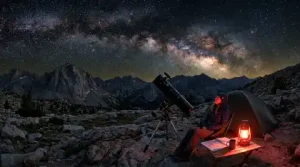
In an increasingly urbanized world where artificial light veils the night sky for over 80% of North Americans, “astrotourism“—or celestial travel—has evolved from a niche hobby into a major travel movement. Travelers are seeking out remote, quiet sanctuaries to disconnect from screens and re-establish a sense of awe under the natural night sky.
Mono County is uniquely geographically tailored for world-class night-sky viewing. Nestled on the eastern slope of the Sierra Nevada mountains, the region combines high atmospheric elevation, extraordinarily low ambient humidity, and vast stretches of protected public land managed by the U.S. Forest Service and Bureau of Land Management (BLM). The result is crystal-clear atmospheric transparency, where stars, planets, and the vibrant core of the Milky Way shine with startling intensity.
Prime Stargazing and Astrophotography Hotspots in Mono County
Whether you are an amateur astronomer equipping a backyard telescope, a passionate night-landscape photographer, or simply a family looking to witness a meteor shower from a cozy blanket, Mono County offers diverse terrain for nocturnal adventures.
1. Mono Lake Tufa State Natural Reserve
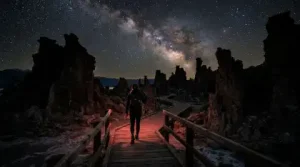
Mono Lake is arguably the most iconic night-sky backdrop in North America. The reserve’s eerie limestone “tufa” towers—calcium-carbonate spires formed by freshwater springs beneath the ancient, hypersaline lake—create dramatic, alien foregrounds for astrophotography.
- South Tufa Area: Accessible via well-maintained boardwalks, South Tufa provides clear, unobstructed views looking south and east toward the dense Galactic Center of the Milky Way.
- Night Atmosphere: On calm, windless nights, the lake’s mirror-like surface reflects starlight, creating incredible dual-layer photo compositions.
2. Bodie State Historic Park
Perched at an elevation of nearly 8,400 feet, Bodie is one of the best-preserved ghost towns in the American West. By day, visitors explore weathered 19th-century wooden saloons and churches. By night, the total absence of artificial light reveals a pristine celestial canopy.
While the park generally closes at sunset to protect its historic structures, state park rangers and local photography groups hold exclusive, limited-entry “Bodie Night Photography Workshops” throughout the summer and early autumn. Capturing the silhouette of a historic stamp mill against a backdrop of billions of stars is a bucket-list experience for serious photographers.
3. Minaret Vista (Mammoth Lakes)
Situated at over 9,200 feet above sea level, Minaret Vista offers sweeping panoramic views of the jagged Minaret Range, Mount Ritter, and Banner Peak. It is easily accessible by car during the snow-free summer and autumn months, making it ideal for visitors who want alpine-level views without strenuous nighttime hiking.
4. Crowley Lake Stone Columns & Bridgeport Valley
For those seeking true wilderness solitude, the mysterious stone columns along the eastern shore of Crowley Lake present a thrilling backdrop. Carved by ancient volcanic activity and wave action, these mysterious stone pillars frame the night sky spectacularly. Meanwhile, further north in the Bridgeport Valley, wide-open mountain pastures framed by the Sawtooth Ridge provide expansive, horizon-to-horizon views devoid of urban glare.
Planning Your Celestial Trip: Seasons, Moon Phases, and Events
To maximize your dark sky stargazing in Mono County, timing your visit around celestial cycles is essential:
- Target the New Moon Window: Plan your trip within three days before or after a New Moon. When the moon is absent from the sky, ambient darkness reaches its peak, revealing the faint, intricate dust lanes of the Milky Way.
- Milky Way Core Season (March to October): The bright, dramatic core of the Milky Way galaxy is visible in the Northern Hemisphere from late spring through early autumn. Early season (spring) presents the galactic arch lying low across the eastern horizon before dawn, while late summer and autumn feature the vertical galactic core rising in the southern sky shortly after sunset.
- Annual Meteor Showers: Mono County’s high elevation provides ideal viewing conditions for major annual meteor showers. The Perseids (mid-August) offer warm summer nights and high meteor rates, while the cold, crisp skies of the Geminids (mid-December) yield brilliant fireball displays for hearty winter adventurers.
Essential Astrophotography & Night Etiquette
Exploring remote high-desert landscapes in total darkness requires proper preparation and respect for fellow stargazers and fragile ecosystems:
- Use Red-Light Headlamps: Human eyes take approximately 20 to 30 minutes to fully adjust to night vision. White light from flashlights or smartphone screens instantly resets night adaptation. Always use red LED settings, which preserve night vision and avoid ruining neighbor photographers’ long-exposure images.
- Astrophotography Camera Settings: To capture the Milky Way, use a camera with manual controls, a sturdy tripod, and a wide-angle lens ($f/2.8$ or faster). Set your ISO between 3200 and 6400, shutter speed between 15 to 25 seconds (to avoid star trailing), and manually focus on a bright star.
- Dress in Thermal Layers: High-desert and mountain temperatures drop rapidly after dark, even in mid-summer. Always pack thermal base layers, windproof jackets, warm gloves, and a thermos of hot coffee or tea.
- Practice Leave No Trace: Stick to established boardwalks and dirt trails, particularly at fragile locations like Mono Lake Tufa Reserve. Tufa towers are delicate, protected geological formations that must never be climbed or leaned upon.
Conclusion: Reconnecting with the Cosmos
In an era where pure darkness is becoming a rare natural resource, Mono County remains a beacon for night-sky lovers. Standing beside ancient tufa towers or atop an alpine vista while peering into the deep cosmos is an unforgettable experience. Pack your camera, layer up, and head east to experience the magic of California’s Eastern Sierra night sky.