Long before gold prospectors, sheep ranchers, or scenic highway travelers set foot in Eastern California, the Mono Basin was home to a resilient Indigenous people who developed a deep, harmonious relationship with one of North America’s oldest lakes. Known as the Kutzadika’a (or Kootzaduka’a), this band of Northern Paiute people has inhabited the shores of Mono Lake for thousands of years, thriving in a high-desert environment defined by extreme seasons, alkaline waters, and rugged mountain passes.
Understanding Mono County’s history requires looking far beyond its 19th-century boomtowns and modern ski slopes. It begins with the Kutzadika’a—the original stewards whose name, culture, and trade networks shaped the cultural landscape of the Eastern Sierra.
Who Are the Kutzadika’a?
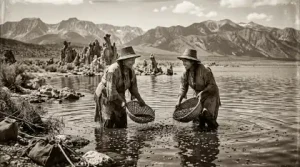 The name Kutzadika’a translates directly to “fly-pupae eaters” in the Northern Paiute language. While European settlers and early ethnographers sometimes viewed the name through an external lens, to the tribe it represents a badge of ecological wisdom and ancestral identity tied directly to a unique food source found nowhere else in such abundance.
Mono Lake is an ancient saline body of water—over 700,000 years old—that contains no fish due to its high salt and chemical content. However, the lake supports a massive ecosystem of alkali flies (Ephydra hians) and brine shrimp. Every summer, millions of alkali fly pupae wash ashore or float in shallow waters along the lake margin. For generations, the Kutzadika’a harvested these nutrient-dense pupae, known as kutzavi, creating a vital food supply that sustained their communities through the harsh Sierra winters.
Seasonal Migration and Life in the Mono Basin
The Kutzadika’a lived a semi-nomadic lifestyle carefully attuned to the rhythms of the Great Basin and Sierra Nevada ecosystems. Rather than remaining in a single permanent village year-round, families moved across distinct elevation zones depending on the season:
- Spring & Summer: Families gathered along the freshwater streams feeding into Mono Lake, harvesting wild plants, berries, roots, and processing the abundant kutzavi along the shoreline.
- Late Summer & Autumn: Bands moved into the surrounding pinyon pine forests on the slopes of the Mono Craters and Glass Mountain to gather pinyon pine nuts (tuba)—a critical staple rich in fats and protein.
- Winter: Communities established sheltered winter camps in lower-elevation valleys or protected canyons where wood fuel and stored pinyon nuts ensured survival through heavy snowfall.
This seasonal round allowed the Kutzadika’a to harvest natural resources sustainably without overtaxing any single micro-environment. Their light footprint on the land ensured that ecological balances remained intact across centuries.
The Trans-Sierra Trade Network
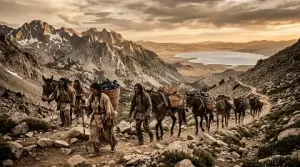 Far from being isolated by the formidable Sierra Nevada mountains, the Kutzadika’a were key traders in a vast inter-tribal commercial network spanning hundreds of miles. They maintained active trade routes across high mountain passes—including Tioga Pass and Mono Pass—connecting the Great Basin with the Yokuts and Miwok peoples of the Central Valley and Sierra foothills.
The Kutzadika’a traded highly prized regional goods, including:
- Kutzavi (Fly Pupae): Highly valued as a delicacy and essential nutrient source by neighboring Sierra tribes.
- Obsidian: Volcanic glass quarried from sites like Glass Mountain and Paoha Island, crafted into sharp arrowheads, scrapers, and knives.
- Pinyon Nuts: Distributed to western Sierra tribes where pine nuts were less abundant.
In return, western tribes traded acorns, shell beads from the Pacific Coast, fine basketry materials, and manzanita berries. These mountain trade routes laid the path for trails that later became wagon roads and modern highways, including Highway 120 (Tioga Pass Road).
Contact, Encroachment, and Historical Struggle
The mid-19th century brought rapid, drastic changes to the Mono Basin. The discovery of gold and silver in nearby Bodie, Lundy, and Aurora during the 1850s and 1860s drove thousands of miners, prospectors, and ranchers onto traditional Kutzadika’a lands.
Settlers fenced off freshwater streams, introduced cattle that grazed away native seed crops, and cut down vast stands of pinyon pine trees to fuel mining operations and heat homes in Bodie. This ecological disruption severely weakened the traditional food systems of the Kutzadika’a, forcing many tribal members to adapt by working for local ranches, mines, and households in towns like Bridgeport and Lee Vining.
Despite these immense pressures, the Kutzadika’a maintained their cultural ties to the lake and surrounding mountains. Families continued traditional pine nut harvests, basket weaving, and cultural gatherings, preserving oral traditions through generations of adversity.
Preserving Cultural Heritage and Federal Recognition Efforts
In the 20th century, the Kutzadika’a faced another major challenge: the diversion of Mono Lake’s tributary streams by the Los Angeles Department of Water and Power (LADWP) starting in 1941. As the lake level dropped dramatically, cultural sites, traditional harvesting areas, and ecological habitats were placed at risk. Kutzadika’a elders worked alongside conservationists to advocate for the protection and restoration of Mono Lake, emphasizing the cultural value of the ecosystem alongside its environmental significance.
Today, the Mono Lake Kutzadika’a Tribe continues to actively advocate for official federal recognition. Though recognized historically in government documents, the tribe was historically omitted from formal federal reservation rolls. Securing federal recognition remains a primary focus, ensuring the tribe receives land sovereignty, healthcare access, educational resources, and a formal voice in natural resource management across their ancestral homeland in Mono County.
Honoring the Legacy of the Kutzadika’a Today
Visitors to Mono County today can engage with and respect this living heritage in several meaningful ways:
- Mono Lake Committee Information Center (Lee Vining): Offers historical exhibits and literature detailing the cultural legacy of the Kutzadika’a.
- Mono Basin Historical Society & Museum: Features artifacts, basketry, and historical accounts from early Native life in the region.
- Respect Ancestral Lands: When visiting Mono Lake, stay on designated trails, do not disturb archeological sites or obsidian flakes, and remember that these shores remain sacred ancestral ground.
The story of Mono County does not begin with silver mines or scenic highways—it begins with the Kutzadika’a. By remembering and honoring their deep connection to the Mono Basin, residents and travelers alike gain a richer appreciation for the land, water, and human history of the Eastern Sierra.